
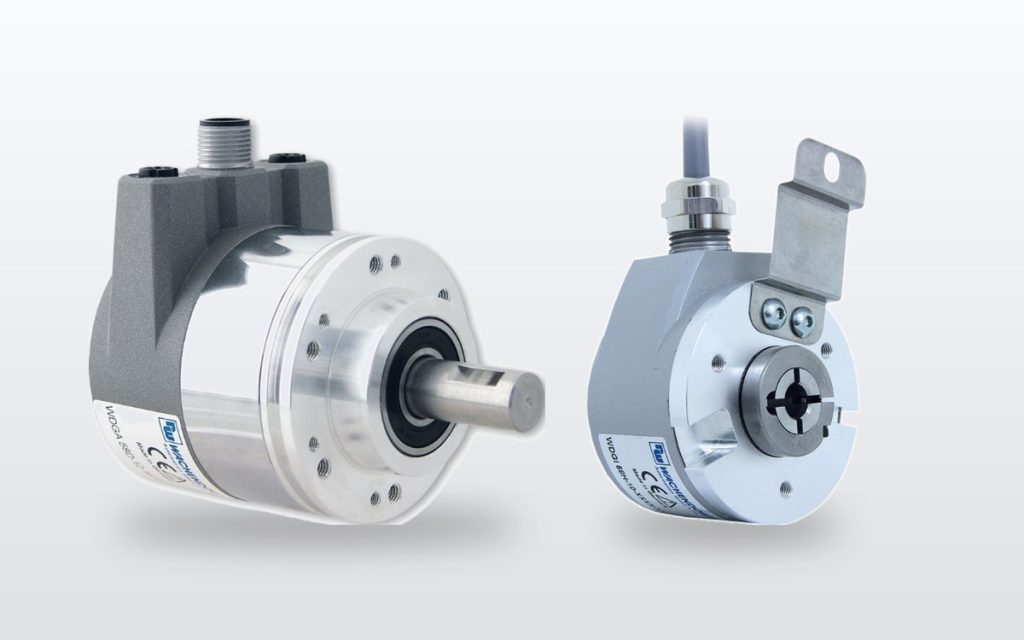
Short answer: choose an absolute encoder when the position must be known at power-up without a homing move, or when losing position is unacceptable. Choose an incremental encoder for speed feedback and for applications where a reference run after power-up is acceptable — it is simpler and usually costs less.
How they differ
- Incremental encoders output pulses (typically A/B channels in quadrature plus an index pulse). The receiving device counts pulses to derive position relative to a reference point. After power loss, the position must be re-established.
- Absolute encoders output a unique code for each shaft position, over one revolution (single-turn) or many revolutions (multi-turn). Position is available immediately at power-up.
Choosing
| Requirement | Incremental | Absolute |
|---|---|---|
| Speed feedback only | Good fit | Works, often unnecessary |
| Position known at power-up | Needs homing | Yes |
| Multi-turn position after power loss | No | Multi-turn models |
| Interface | TTL/RS422, HTL | SSI, BiSS, fieldbus and others |
| Sensitivity to missed pulses | Errors accumulate until next reference | Each reading is independent |
When replacing an encoder
Match the electrical output (TTL vs HTL levels, supply voltage), resolution, mechanical mounting (solid vs hollow shaft, flange, coupling) and protection class. If an exact match is not available, a level converter or splitter can often adapt a new encoder to an existing drive or counter.
Problems that look like encoder faults — lost counts, drifting position — are frequently caused by cabling, shielding, grounding or coupling slip. Check the whole signal path.